
searchMenu

The 31-meter-high Bismarck Tower was built from 1907 to 1912 by the recently founded Rheinhessen Bismarck Association on the Westerberg. It was intended as a symbol of patriotic sentiment and as a counterpart to the Niederwald Monument erected in 1871 near Rüdesheim. The architect Wilhelm Kreis from Eltville designed a building type using elements of Art Nouveau and Neo-Romanesque that became significant for the construction of similar monuments in honor of Bismarck throughout the German Empire. Rough-hewn blocks of limestone from…

Since its reopening in 1991, the Frankfurter Hof in Mainz's old town has established itself as a central cultural center of the city. National and international artists make the venue widely known beyond the Rhine-Main area. The program includes a diverse spectrum of music, theater, exhibitions, classical music, pop culture, and multicultural offerings. During the concert series "Summer in the City," more impressive open-air locations in Mainz are also used in the summer. The history of the Frankfurter Hof dates back 175 years: In the…

A special feature among the vineyard cottages, which served as shelters for farmers and winegrowers throughout Rheinhessen, are the trulli. Like white sugar loaves, they shine between the rows of vines. Three of them can be found in the region around Flonheim. The name comes from the roundhouses that are mainly found in Apulia/Italy. In our region they were built in the 18th century as shelters in the vineyards, although there is no historical evidence as to whether the round houses from Puglia served as a model or not. One of the most…

The parish church in Gabsheim is one of the oldest and most beautiful churches in Rheinhessen. Its commanding location above the village makes it a prominent point for the entire surroundings. The exterior of this uniformly styled Gothic church at the edge of the village surprises with its magnificent interior. The single-nave longitudinal building, constructed around 1490, was converted into a hall between 1510 and 1518. The relatively short space, divided by four pillars into three equally high ships, is spanned by a sophisticated net…
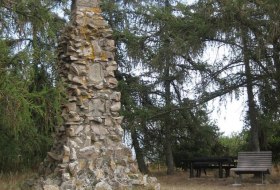
The eagle monument is situated on the Mühlberg and is a war memorial from the first world war. Probably it was already inaugurated during the war what was really unusual during this time. The building type, it's created with field stones, also makes it special.
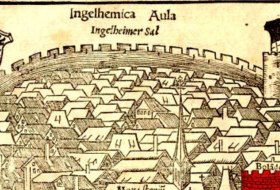
This defensive tower is a part of the Staufer fortifications and was presumably established around 1160. The “Bolander” secured the southwest side of the Ingelheim palace and the “Rheingässer Tor.” An early pictorial representation of the hall area (name of the archaeological zone Kaiserpfalz Ingelheim since the early modern period) from the year 1545 by Sebastian Münster shows the original multi-storey tower with arrow slits and battlements (illustration in the museum at the Kaiserpfalz). The name…

The cabaret stage Oberhaus is a cultural highlight of the city centre in Alzey and offers a diverse program for every taste. No matter if it's comedy, cabaret or a live band, the stage offers enough space for every kind of art. Apart from that the visitors can take part in whiskey tastings after their registration or they can prove their skills at a darts competition. Also there are parties in the Oberhaus on a regular basis. The counter is with a length of ten meters one of the longest in Alzey, the musical entertainment is diverse, they…
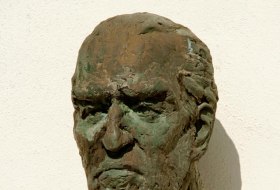
Carl Zuckmayer set a literary monument to his birthplace Nackenheim with his play "The Merry Vineyard". Open-air performances of his works take place here regularly. You can find out about his family history in a permanent exhibition in the local museum. A bust in front of the town hall commemorates Nackenheim's most famous son.