
searchMenu
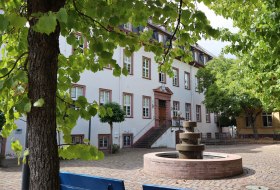
Leiningen Castle, located in the town center, has a multifaceted past. The shell of the building was completed in 1708, but no further extensions were made at first as the owner at the time, Count Carl Ludwig von Leiningen-Dagsburg-Falkenburg, died in 1709. His wife, Countess Anna Sabina von Nostitz, sold the estate to the Electoral Palatinate Privy Council in 1717 due to financial hardship. In the years that followed, the castle fell more and more into oblivion until 70 years later, in 1787, a member of the Leiningen family once again became…
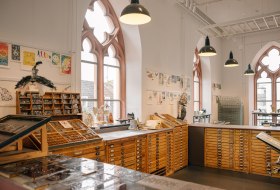
The printing shop in the Gutenberg Museum Mainz serves as both a print workshop and an experimental laboratory, forming the central museum educational offering of the institution. Here, visitors of all ages – from children to teenagers to adults – can experience the "black art" of printing up close, design their own printed materials, and experiment with lead and wood types as well as printing presses. Numerous workshops, guided tours, and creative programs such as children's birthdays or holiday offers convey the history of the…
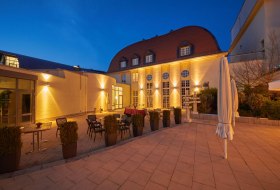
After a chequered history, culture moved into a building erected in 1925 for the Freemasons in 2003. Seminars, conferences, theatre and concerts take place in the pleasant and spacious ambience of the House of the Guest and ensure a varied programme all year round. The concert and theatre hall is the centre of the House of the Guest. There is room for about 200 visitors. Two seminar and lecture rooms are also part of the room programme. The ideal place for conferences and congresses. Exhibitions by contemporary artists enrich the…
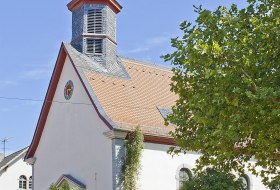
Discover the Protestant parish church of Undenheim, a small country church with a fascinating history. Over the years, it has been redesigned time and again, giving it its cozy charm and making it a special place. During the renovation work in 1926–1927, the impressive mural behind the altar depicting Jesus Christ was created. This work of art was created by Otto Linnemann, a well-known artist from Frankfurt am Main, and still characterizes the interior of the church today. The organ inside dates back to 1905 and was built by the…

From 1887 to 1888, the tower designed by architects Anton Louis and Johann Doll was built. Originally, it was to be a wooden tower, which was planned to be constructed on the western part of the Rochusberg, the so-called Scharlachkopf. However, the funding was initially lacking. After the death of longtime Bingen mayor Eberhard Soherr, the idea could be realized. He had stipulated in his will that 10,000 marks should be spent on the construction of a solid tower made of basalt lava and sandstone. The name Kaiser-Friedrich-Turm goes back to…
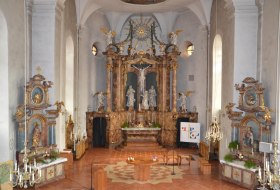
In Ockenheim, the Catholic parish church of St. Peter and Paul invites you on a journey into the past. The building from the late 18th century impresses with its baroque architecture and the magnificent saint figures. The tower proudly rises above the village, and the interior is a true masterpiece of baroque art. It's worth taking a moment to pause and let the spiritual atmosphere affect you.
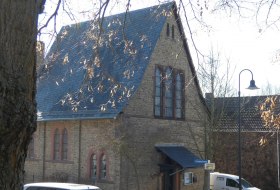
The building is in neo-Gothic style and features a rectangular choir apse. There is a beautiful rose window on the choir wall. The ceiling is artistically and richly decorated with ornaments designed in a green tendril pattern with fruits and flowers, symbolizing creation. A highlight is the Rococo Madonna, restored in 1999, which now stands on a sandstone stele in front of the left front wall, in front of the choir. In 1998, the church was expanded with the addition of a choir extension and a new sacristy.
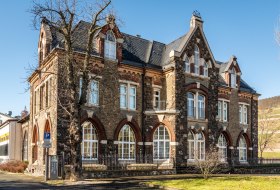
With the Hildegard jubilee in 1998, the Historical Museum on the River - Hildegard von Bingen, the former electricity generating station on the bank of the Rhine River, opened its doors. There is a large department dedicated to Hildegard, the universal scholar and theologist. The museum offers something very special: a complete set of surgical instruments from the Roman days, discovered during renovation work in Bingen. A further department focuses on the Rhine Romantic epoch. In a unique way, the 200-year epoch is illustrated using, among…