
searchMenu
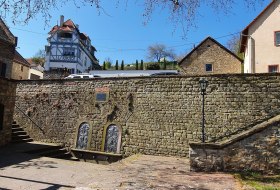
The Julianenbrunnen, popularly known as the Giljebrunne, is a 400-year-old fountain in the center of the Guntersblum Kellerweg, which is famous for its great wine festival. The building is now considered a cultural monument. Unfortunately, the exact age of the Julianenbrunnen is unknown. The first mention of a fountain at this location dates back to 1472, but the spring has probably been fortified for longer. The Julianenbrunnen was first officially documented in 1608. At this time, the fountain was renovated and the year was carved slightly…
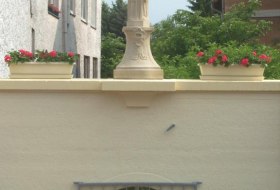
As a "bridge saint," John of Nepomuk was drowned in the Vltava River in 1383 because he refused to reveal the confessional secret of the queen. His statue from 1771 was stolen and replaced by a new statue in 2005.

The central attraction of the Rochusberg is the pilgrimage church of St. Rochus, built in 1895 in neo-Gothic style. The first chapel was built on this site in 1666. The Rochus pilgrimage with Rochus festival also goes back to this time. A special feature is the Hildegard and Rupertus altar from 1895: The Hildegard altar shows scenes from the lives of the saints (outside of the service times only the church vestibule is open). In the Hildegard Forum of the Sisters of the Cross, exhibitions, lectures and seminars deal with the saint. A…
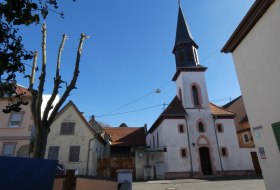
The present church, dedicated to St. Joseph, was built in 1891 and stands on the site of the Ursula Chapel, which was erected in 1745 and of which two sections of wall remain. During the First World War, the bells were melted down, and three new ones were cast in 1934, but two bells had to be surrendered again during the Second World War. In 1965, the church was extensively restored and given new windows. Particularly noteworthy is the rose window above the altar in the choir room, which depicts the Good Shepherd and scenes from the New…
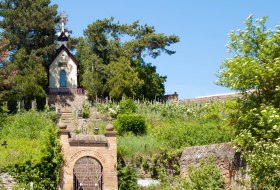
The chapel and tower of Villa Heiligenblut were built in the Romantic style in the 1780s. Today, civil weddings can be held in the chapel, which is owned by the Gerhard Hannemann family.

The Bad Kreuznach Puppet Theater Museum presents a fascinating permanent exhibition on puppet theater culture worldwide and in Germany. Visitors experience the history of the Augsburg Puppet Box and the Salzburg Marionette Theater up close, from the carving workshop to the finished wooden head. The UNESCO-recognized puppet play traditions, from Chinese shadow figures to Sicilian knight marionettes, can be seen, and with 55 (!) interactive stations, the exhibition allows for SELF-EXPERIENCE, PARTICIPATION, or LISTENING. The PuK Museum will be…

The parish church was built in 1808 on the site of a church that was demolished due to dilapidation. The consecration took place in 1810. The tower of this church is about 50 years younger.

The Protestant church in Dexheim looks back on an eventful history: Dexheim's St. Martin's Church was first mentioned in documents in 889; it was first referred to as “St. Martin's Parish Church” in 1341. During the Thirty Years' War and the subsequent War of the Palatinate Succession, it was almost completely destroyed, with only the church tower remaining intact. The church was gradually rebuilt. Major renovations took place in 1957 and 1958.