
searchMenu
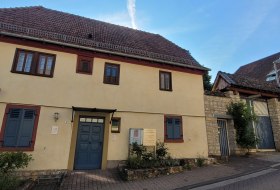
A large plot of land in the 'Kirchgasse' north of the old Kirchweg was once held as a fief by the mayor Emmerich von Engelstadt from the Counts of Nassau. After his death, his descendants received all properties in Wackernheim as freehold in 1485. From 1819, the elongated estate was in the possession of the Michel family. The farmer Jakob Michel had the large basement barn (now Kirchstraße 2a) built in 1856 and enclosed the farm with a wall on the street side. In the process, the already existing outbuildings were dismantled. The gate…
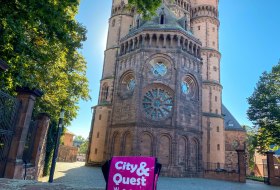
For those who enjoy solving puzzles and exploring cities in teams, "City&Quest" is an exciting, creative way to discover the city of the Nibelungs. Visitors can choose between a German or English version of the game. The game starts at the cathedral. From there, the approximately 3 km long route leads to 11 more puzzle stations worth seeing - most in the middle of the city centre, some a little outside. The tour takes about 2.5 hours on foot. With the help of the mobile phone's GPS function and a free app, you can find your way around…
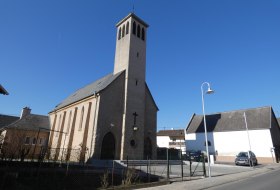
The Catholic Church in Köngernheim is a branch church of St. Walburga in Friesenheim and today belongs to the parish of St. Mary Magdalene. Since its foundation in 2016, this parish has comprised the parishes of Friesenheim, Undenheim, and Weinolsheim. The church was consecrated in 1932. The interior of the church building is a simple space.
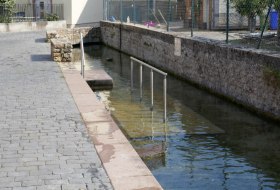
Kneipp Health Facility Please note the following: An important principle when using cold water is that the body must be actively warmed beforehand. Never start an arm bath or foot bath with cold hands or feet! So, if you are not warm yet, make up for it now with brisk movement, such as gymnastics or running. Water treading: lift your feet out of the water with every step (stork walk). Stay in the water only until a strong cold stimulus occurs in your legs. Afterwards, shake off the water and warm up. Have fun and good health wishes…
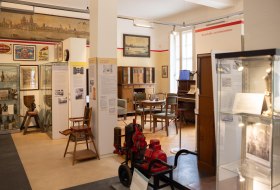
Somewhat hidden behind the café and directly next to the Drusus Stone on the Citadel lies the City Historical Museum in Building D – opened in 2003, but still almost a insider tip. The museum is a private institution and is funded by membership fees, donations, and entrance fees. The sponsor is the Mainz City Historical Museum Association, which was founded in 1996. The museum offers a comprehensive overview of the history of the city of Mainz, but places a particular emphasis on social and economic historical aspects. Exhibits…

During the Reformation, Spiesheim had a parish church dedicated to Saint Stephen, which served the Reformed community as a place of worship until 1706. Due to the Palatine church division, the community lost its church and acquired a barn "Auf dem Liding," which was subsequently used for services. Initial plans for a new church were created in 1788, and a year later, the foundation work began. However, financial constraints, French occupation, two wars, and the integration of Rheinhessen into the Grand Duchy of Hesse-Darmstadt delayed…
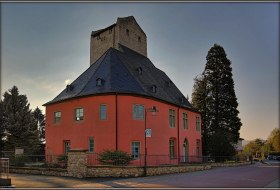
Windeck Castle in the centre of the district of Heidesheim was built by the knight Herdegen zu Winternheim in 1209 in the style of a tower castle with Gothic residential buildings. Originally, it was probably a moated castle with a moat and a curtain wall. Various owners used the castle as a residence, tannery and perforated mill, but also for religious services, before the municipality of Heidesheim am Rhein acquired it in 1993 with the aim of saving it from decay. Today, the building houses a community centre, a mayor's office and a wedding…

The historic site where Martin Luther was questioned before emperor and empire on 17th and 18th April 1521 is today situated in a romantic landscape garden, the Heylshofpark. The former bishop's court that stood on this site was destroyed in 1689. The residence of the bishop of Worms was built on the north side of the cathedral until the destruction of the city in 1689. King Charles V lived here during the 1521 Reichstag, and Martin Luther was brought here on 17 and 18 April, where he acknowledged his writings and refused to revoke them: It…