
searchMenu

The museum exhibits original finds from the Urrhine near Eppelsheim, which are around 10 million years old, and casts or copies of rare fossils. These include teeth and bone fragments of rhinoceroses, great apes and proboscis animals such as dinotheria and mastodons. Single specimens of the primeval horse, tapi r( claw-footed hoofed animal), Muntja deer, bear hound, beaver and pig are also on display. The centrepiece of the museum is a cast of the skull of a Dinotherium (Dinotherium giganteum), which was recovered from Klipstein and Kaup in…

The Mennonite David Möllinger acquired the property at Hauptstr. 34 in 1744, later also the neighbouring farms and other land on a large scale. He practised arable farming, where he was able to contribute significantly to the abolition of three-field farming through fertilisation. He bred pigs and kept up to 40 fattened oxen. He grew grapes, distilled schnapps and brewed beer, which he stored in the cellar under the "Villa Fliedner". As a recognised economist, he became the purveyor to the court of the count of…

The Schillerplatz is one of the central and historically significant squares in Mainz. Named after the poet Friedrich Schiller, it is today a lively meeting place with a striking historical backdrop, characterized by magnificent noble palaces such as the Osteiner Hof and the Erthaler Hof. Its baroque appearance bears witness to the urban development of past centuries, and the square is closely linked to the Mainz Carnival: Every year on November 11th, the fifth season is ceremoniously opened here. In the center of the square, the Carnival…
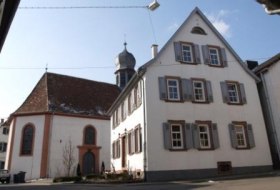
Former Lutheran church, built 1738-42 in rural baroque style - tower 1930, three-sided hall, stucco ceiling and furnishings from the time of construction, "pneumatic cone chest organ" from the workshop Förster & Nikolaus Lich/Upper Hesse from 1915, also called winter church, since the installation of a church heating system at the end of the 19th century. Text Signposting with kind permission of the Orsgemeinde Flörsheim-Dalsheim This location is part of an audiovisual route and offers the possibility to watch/listen to…

The foundation is intended to preserve and cultivate the life's work of the sculptor Eberhard Linke, to make his works accessible to the public, to make them scientifically accessible and to place them in the history of art. At the same time, the Foundation promotes younger artists and offers working stays and courses in the Foundation's premises in Flonheim for the hollow construction of terracotta sculptures. The studio regularly hosts concerts, readings, film screenings and lectures.
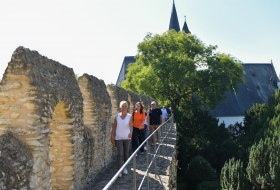
The all-around accessible main wall was mainly constructed in the 15th century. Its most vulnerable flank at the Mainzer Berg was strengthened by the addition of a Zwinger (inner defence gate). The only entrance (at Grabengasse/Kirchgasse) received an outer gate, a so-called “Barbarkane”. The second, southern breach was created in 1873 and provided access to the vineyards. The most salient point is the so-called Malakoff tower - formerly the “Alte Wache” (old guard post) with its dungeon. It offers an impressive…

In the cross vault of the Engelthal Monastery fine seasonal dishes are offered. Matching every dish there are in-house wines. General information on this typical kind of Rheinhessen vault, called "Kuhkapelle" (cow chapel) The origin of the typical Rheinhessen vaults goes back to the early 19th century. At that time, farmers wanted to increase the yield of their cattle by keeping them in stables and use the leftovers as fertiliser for their fields. Initially, the cattle were housed on the ground floor of the half-timbered houses, above…

At the entrance to the Ulmengraben on Pariser Straße, opposite the catholic church at the “Neutor” square, stone frames in gallows shape stand. These so-called “rests” were formerly used by peasant women to set down their burdens, and were originally located in the “Oberfeld”, i.e., the area above the Schlossberg. Moreover, at Neutor there is still a column from the former Wörrstadt Castle.