
searchMenu

The Mainz Cathedral has experienced a lot in its more than 1,000 years. At the junction of significant trade and traffic routes, the city developed into a religious center north of the Alps and received the honorary title "Holy See." Archbishop Willigis had the cathedral built from 975 based on the model of the old St. Peter's Basilica in Rome. However, the first grand celebration ended differently than planned: On the day of the consecration in the year 1009, a fire broke out and destroyed the new building. It was not until 1036 that the…

In life-size, Johannes Gutenberg rises on the square named after him. The bronze statue is crafted by the Danish sculptor Bertel Thorvaldsen and depicts the inventor of the printing press in an idealized form: bearded, elegantly dressed, with a Bible and typefaces in hand, as no contemporary portrait exists. At the inauguration in 1837, the people of Mainz celebrated for three days. Even today, the Gutenbergplatz around the monument is vibrant, especially during the Johannisnacht at the end of June, when the festival in honor of the famous…
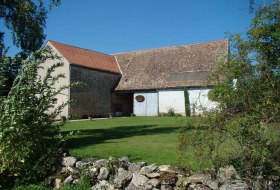
The Johanniterhof was first mentioned in a document in 1306. Parts of the building fabric are even older. After 500 years of belonging to the Order of St. John, the estate was divided into three manor farms under Napoleon. The former size of the entire complex is still clearly recognizable today.
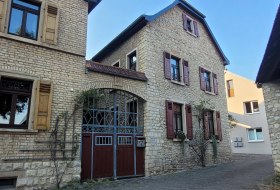
Here once stood the Catholic school building, which was built in 1857. Already in 1850, the Catholic priest of Heidesheim, Heinrich Berthes, had promised the church fund the donation of this property. It was to serve as housing for clergy, accommodation for the organist and the bell ringer, as well as a classroom for the Catholic confessional school. Until the introduction of communal schools, the Catholic teacher Josef Becker from Heidesheim lived and taught here. Afterwards, the house was rented out and finally auctioned off in 1896 to…
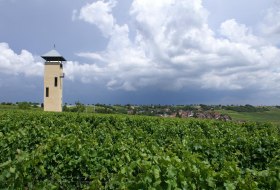
Above the village, the "Rondell" – a natural monument – offers a resting place for hikers and cyclists. The Rheinhessian Jakob Pilgrimage Trail, which is also suitable for cyclists in this area, leads directly past the new Vendersheim Tower. From here, you have a wonderful view over the Rheinhessian landscape and its vineyards all the way to the Donnersberg and, in good weather, to the skyline of Frankfurt. At the large winemaker's table next to the tower, even large groups can comfortably take a break together at one table.

On the KulTOUR from the castle tower to Froschmühle Nierstein-Schwabsburg, you will travel back to the 13th century and learn more about the old bakery in Schwabsburg and the Froschmühle. The tour starts at the Schwabsburg castle tower. All you need for this tour is a smartphone with a QR code scanner. Each building on the tour has a QR code with interesting facts behind it. A total of 6 stations invite you to get to know Nierstein-Schwabsburg better on your own. After the tour, you can stop off at one of the restaurants around the…
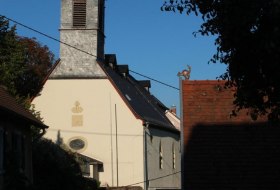
The church was built in 1712 in place of the destroyed Michaeliskapelle and later remodeled and expanded with neo-Gothic forms. Beneath the nave is a vaulted medieval ossuary. Due to the limited space of the cemetery, the bones that were excavated during reburials were collected and stored there. It was already mentioned in 1496. Later, it was abandoned and fell into oblivion. It was only rediscovered in 1981 during construction work. History / Stories / Anecdotes: The ossuary was discovered on October 3, 1981, during construction work in…
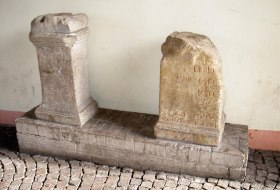
The cult of Mithras was brought to Mainz by Roman legionaries as early as the 2nd century. It was in direct competition with the emerging Christianity, as both religions showed some parallels. The underground sanctuaries, called Mithraea, consisted of elongated vaults with a Mithras altar at the end and were painted to resemble the starry sky. The followers of the cult therefore met underground, but symbolically under the canopy of heaven. The well-preserved altar is made of Odenwald marble. Its originally red inscription reads: “To…