
searchMenu
Bad Münster am Stein-Ebernburg
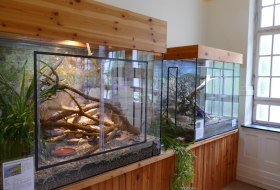
The museum “Naturstation” located in the Kurmittelhaus is an ideal setting for the presentation of the Nahevalley with its unique variety of plant and animal species. The flora and fauna of the region are presented. It focuses on the issue of native snakes, lizards, frogs, toads and newts in species-appropriate terrariums. Ongoing projects to stabilize the population of the dice snake or to restore the riverbank and floodplain forests for the protection of rare species are presented.

For several centuries, ship mills operated on the Rhine River near Ginsheim. Up to 21 of these floating small businesses for grain processing were anchored here simultaneously, before they had to make way for the rising industrialization and increasing shipping traffic. Today, the authentic reconstruction of the last productive Rhine ship mill offers interesting and exciting insights into the technology and working conditions of past times.
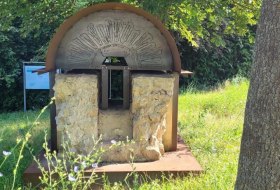
Here you see a section of an early medieval long-distance water pipeline. It was found in 2004 in close proximity. Scientifically, it has been dated to the construction period of the Imperial Palace, namely the late 8th century AD. The long-distance water pipeline supplied high-quality drinking water from the spring area "Karlsquelle" near Heidesheim through the Wackernheimer Valley to Nieder-Ingelheim, into the palace of Charlemagne. This was achieved through a 6.8 km long canal, which mostly ran underground. The structure, built from…

If you want to discover the region from a different perspective, the "Balcony of Rheinhessen" is the perfect spot. This viewpoint offers breathtaking views of the Rhine Valley and the Donnersberg. Here, you can immerse yourself in the vastness of the region - ideal for a moment of relaxation in the heart of nature. On clear days, the view even extends to the Taunus!

This defensive tower “die Schnecke” (the snail) controlled the former defensive wall, situated between the midle Altegässer and the now equally torn down Hammergässer Gate, (crossing: Unterer Zwerchweg/Mühlstraße). The weighty building from the end of the 14th century was still not roughcast in1900, so that the interesting construction of foundation and pointed cone roof can be easily recognised, a technique that can also be seen on the “Trulli” in the vineyards.

Join us on an exciting and impressive discovery tour in the heart of the medieval old town of Oppenheim. Our friendly and knowledgeable guides will show you the diverse facets and sights of our historically rich city - and of course some mysterious corners as well. Because it is certainly thrilling to follow in the footsteps of the many famous Oppenheimers and guests of the city, such as the Imperial Herald Kaspar Sturm, copper engraver Matthäus Merian, the builder of the Reichstag in Berlin, Paul Wallot, Martin Luther, or Albert…
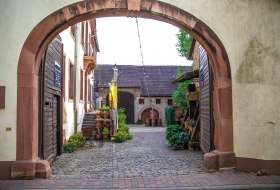
On the KulTOUR around the Nierstein market square, you can expect exciting stories about Nierstein's noble courtyards, underground secret passages and the old village smithy. The tour starts at the Haxthäuser Hof in Langgasse 35. All you need for this tour is a smartphone with a QR code scanner. Each building on the tour has a QR code with interesting facts behind it. A total of 16 stations invite you to get to know Nierstein better on your own. After the tour, you can stop off at one of the restaurants around the market square or start…

Gallé-Blick Before the Gallé family acquired the Heisje, it was almost completely dilapidated. Since then, it has been restored and is lovingly maintained. Above the door is the Gallé family crest with the year 1988. The protruding canopy is meant to resemble the shape of a barrel. Height: 186 District: "Am Hinkelstein" History / Stories / Anecdotes: The Heisje was almost completely dilapidated and was lovingly restored by the Gallé estate. The family keeps it in good condition and also brings…