
searchMenu

Looking into the universe from the Kuhberg The observatory Bad Kreuznach's window to the universe opens on the Kuhberg. Here, the "Sternwarte Bad Kreuznach e.V." association has maintained a public observatory since 1986, opening up the fascination of outer space to interested people of all ages. The flyby of Halley's comet, which is due every 76 years, gave the impulse for the foundation of the association. The 40 members first invested in the construction of professional equipment, their greatest pride is the solar telescope. Every Sunday…
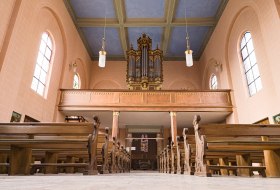
The Catholic parish church of St. Peter in Ketten is a single-nave hall building with coffered ceiling, built in 1725 in the neo-Gothic style in the centre of Gau-Bischofsheim. The choir windows were designed by the well-known painter and glass artist Heinz Hindorf in collaboration with the glass workshop R. Münch. The weather vane on the church tower shows the church's namesake, St. Peter. In the 1990s, the church was extensively renovated and refurbished. The “Johann Geissel organ” in the church is the oldest church…
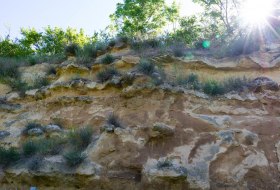
The Geotope in Alzey-Weinheim shows sea deposits from the time of Tertiar (Oligozän) over 30 Million years ago. It is also a former seabed, not a coastal cliff.
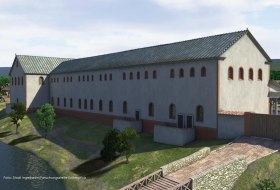
The demolition of dilapidated buildings in 2011 enabled archaeologists to examine the the now exposed façade of the north wing. This was built during the Carolingian foundation phase of the Ingelheim Palatinate. The 60 metres long and eleven metres deep, it was possibly used as a residential wing. metres deep, was possibly used as a residential wing. Today, the renovated façade of the north wing can be seen in the monument area. can be visited. Two arch embrasures in the wall date from the 12th century, when the palace was…
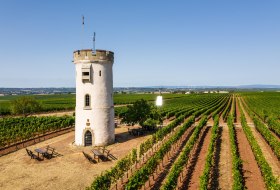
Above the town of Nierstein, located to the north in the Red Slope, lies the Wart Tower – the landmark of the town and one of the most beautiful viewpoints in the region. From here, an impressive panorama of the vineyards and the Rhine Valley opens up, extending to the Donnersberg, the Hessian Bergstraße, into the Taunus, as well as to Wiesbaden, Mainz, and the Rhine-Main area. Its origin dates back to a medieval signal tower from the 12th century. The stones from the demolished Kings Chair between Nierstein and Lörzweiler…
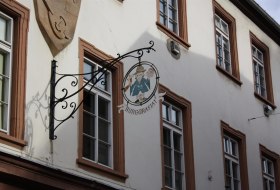
The exhibitions in the series "Art in the Burggrafiat" take place in regular intervals and showcase artworks of all kinds. Info: www.galerie-alzey.de
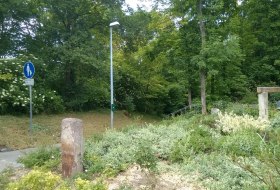
The village trench in Wörrstadt is a valuable heritage from the Middle Ages. First documented in the 13th century as “Zingele,” it is a worthy green lung in today’s urban area with its rich tree population. As a vegetated defensive structure, the trench enclosed the entire village area until the early 19th century. Until the 1980s, the trench was mostly planted with centuries-old elm trees, also called Effen. They all fell victim to the elm bark beetle and were replaced by other tree species. Since the spring of 2015,…
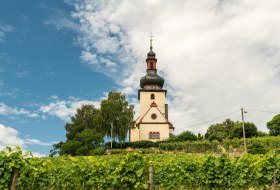
Discover the fascinating history of St. Kilian's Church in Nierstein! The Kiliansberg hill was already a place of worship in Roman times. Over the centuries, St. Kilian's Church was rebuilt several times. In 1767, it was destroyed by fire and rebuilt. Today, it impresses with a Baroque nave, a baptistery, and a tower whose lower floors date back to the Carolingian period. The onion dome with its Baroque cupola makes the church a special historical and architectural highlight.