
searchMenu
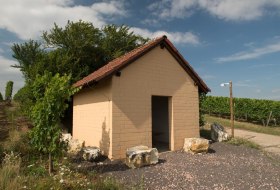
The Wineyard-House "Schindegaul" is a small refuge which, like many others of its kind, offers shelter or a dry shelter to winegrowers, but also to hikers or cyclists in bad weather.
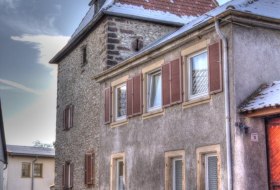
Built in the 14th century. The lords of Kriegsheim built this building, which is probably the oldest preserved residential building in the municipality. In the 16th century, the residential tower belonged half to the Counts of Leiningen-Hartenberg and half to those of Rodenstein. The three-storey building radiates a certain security and tranquillity, which the observer still feels today. The residential tower is privately owned. Text taken from Rundgang Kriegsheim with kind permission.

At the mouth of the Nahe into the Rhine - a wonderful spot for views of the Upper Middle Rhine Valley and the Rheingau. Perfect, as the sun sets directly behind the Mouse Tower.
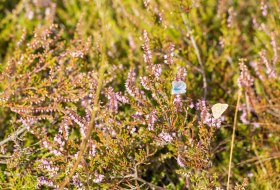
The Siefersheim Höllberg comprises a rocky hilltop of rhyolite with a rare plant community of e.g. rock pears, medlars, roses and heather as well as a dense ring of woody plants on the slopes.

The Trinity Church on Worms' market square is a "Reformation Memorial Church" that recalls the beginnings of the Reformation in Worms. The foundation stone was laid on 31 July 1709 and the church was consecrated sixteen years later. Largely destroyed during the nights of bombing in February and March 1945, it was rebuilt by Bauhaus architect Otto Bartning from 1955 to 1959. In the top of the tower there is a carillon that plays songs from the Protestant hymnal that are appropriate for the church year. Wilhelm Buschschulte created biblical…
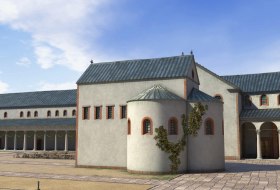
In 2004, two predecessor buildings of the Saal Church were discovered during archaeological excavations on the Saalplatz. The older of these buildings is a so-called tri-apsidal church (Trikonchos), named after its three semicircular building ends, which resemble the shape of a cloverleaf remember. It is an ancient building with a reference to Byzantine architecture. The eleven metre long sacred building from the 8th or The 9th century was connected to the north wing. Recent research suggests that it was a stately private chapel. Later the…

Heute ev. Gemeindehaus, Gründung im 9. Jahrhundert durch Kloster Hornbach. Der romanische Turm ist aus dem 13.Jh. Im Pfälzer Erbfolgekrieg 1689 teilweise zerstört und 1707, nach der Pfälzer Kirchenteilung, an reformierte Gemeinde übergeben danach Wiederaufbau 1708-1712 mit barocker Turmhaube aus dieser Zeit. Stummorgel und Holzausstattung aus dem 18. Jahrhundert. Auch Sommerkirche genannt, da damals keine Kirchenheizung vorhande. Seit 1979 wird das Gebäude als Gemeindezentrum genutzt Text Beschilderung mit…
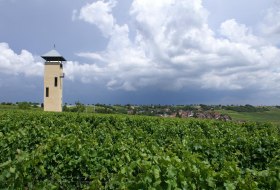
Above the village, the "Rondell" – a natural monument – offers a resting place for hikers and cyclists. The Rheinhessian Jakob Pilgrimage Trail, which is also suitable for cyclists in this area, leads directly past the new Vendersheim Tower. From here, you have a wonderful view over the Rheinhessian landscape and its vineyards all the way to the Donnersberg and, in good weather, to the skyline of Frankfurt. At the large winemaker's table next to the tower, even large groups can comfortably take a break together at one table.