
searchMenu

An event venue with a WOW effect! Visitors to the kING Kultur- und Kongresshalle experience cultural enjoyment at the highest level! With 324 windows and hardly a straight wall, it is an architectural eye-catcher in the centre of Ingelheim. However, its true greatness is revealed inside: Since its opening in 2017, the multifunctional concert and congress hall has enriched Ingelheim's cultural life with a varied programme of events and attracts people from the region and far beyond to the red wine town. Whether concerts or musicals, shows…

Rich collection from over 200 years of winery history and development of the general wine growing.
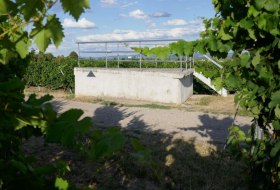
The Heisje was built during the war as a bunker for the Osthofen Flak observation post. After the war, a wooden cabin was built on the bunker as a Wingertsheisje. Parts of it are still present today. In 2014, the Osthofen Wine Ring renovated the bunker as a viewpoint, which offers beautiful views all the way to the Bergstraße and is a popular photo hotspot. Architectural Details: triangular base form, designed as an observation platform, with stainless steel staircase and railing the bunker entrance was bricked up during the…

In 2010, the site of the starling defence transmitter was converted into an approx. 4 m high observation tower with a great view of the Rhine plain, Flörsheim-Dalsheim and the surrounding area, and in 2016, panorama panels describing the view were added.

Epitaph at the Windhäuser Hof in honor of Jeanbon Saint-André, created to commemorate his 200th anniversary of death in 2013. Jeanbon Saint-André served as General Commissioner of the four left bank Départements established in 1798 under Napoleon Bonaparte starting in 1801. From February 1802, he acted as the French prefect of the Département du Mont-Tonnerre based in Mainz. In 1809, he acquired the Windhäuser Hof, which he subsequently used as a summer residence.

An diesem Aussichtspunkt mit Ruhebank hat man einen herrlichen Blick über den Rheingau bis zum Binger Loch.
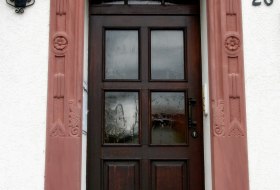
The door frame of the private property Zuckerberg 26 dates from the year 1612. At this time Ingelheim was under the government of the Electorate of the Palatinate. The door frame is no longer in its original position today Place, but probably belonged to the Electoral Palatinate Schaffnerei, which in the area of former Aula regia (throne hall) had been built. The Schaffnerei was the seat of the government administrator, who in Ingelheim Represented the interests of the Electoral Palatinate. Under the Ingelheim taxes to the Kur- pfalz were…

The church of this relatively rare religious community in the area was inaugurated in 1890 after only six months of construction.