
searchMenu

Oppenheimer Toad Fountain Those walking along the RheinTerrassenWeg will pass by the Oppenheimer Toad Fountain. This famous vineyard site owes its name to an old water system that once served the city's water supply. An approximately 30-meter deep, now decommissioned tunnel captured rainwater there and channeled it to Oppenheim. Today, this spot is a popular resting point for hikers. From here, there is a great view of Oppenheim and the vineyard landscape.
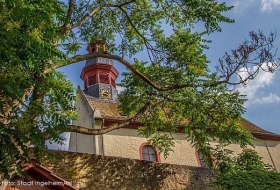
Already in 788, a church dedicated to Saint Martin is mentioned in a document from Fulda. At that time, the church was in the possession of the local noble family of Otakar. In 1348, it belonged as a parish church to the Wackernheim church community. In the mid-16th century, at the instigation of the Electoral Palatinate, first the Lutheran and then the Reformed confession was introduced. During the church division, the heavily damaged church, which had been severely affected by the Thirty Years' War, fell to the Reformed, who made up the…

Digital tour, developed in a cooperation between the Research Center Kaiserpfalz Ingelheim and the Museum bei der Kaiserpfalz, which you can view on YouTube . It is led by Miriam Maslowski, historian and art historian (Museum bei der Kaiserpfalz). She introduces a number of outstanding women personalities of the High Middle Ages: They were all rulers who had an amazing wealth of power and even directed the fortunes of the Holy Roman Empire for a certain time. There is also evidence that all five empresses stayed in the imperial palace in…

The Winzerkeller is not just a piece of Ingelheim's wine-growing history. It still characterises the face of the town today and bears witness to a great cooperative achievement. The multimedia wine experience exhibition brings this history back to life. At the centre of the permanent multimedia wine experience exhibition on the second basement floor, everything revolves around the history of the Winzerkeller and the people who laid the foundation stone for this extraordinary building almost 120 years ago. Step into the experience…
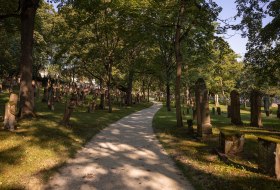
In 1880, the city architect of Mainz, Eduard Kreyßig, established a new Jewish cemetery on Untere Zahlbacher Straße next to the main cemetery of Mainz. This ended the use of the old cemetery Judensand on Mombacher Straße. A memorial plaque at the entrance has commemorated since 1948 with the inscription: "In memory of our victims. To the shame of the murderers. As a reminder to the living." The graves remained intact during the Nazi regime and wartime, and to this day, members of the Jewish community are buried here. The…
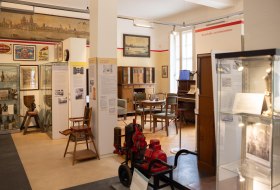
Somewhat hidden behind the café and directly next to the Drusus Stone on the Citadel lies the City Historical Museum in Building D – opened in 2003, but still almost a insider tip. The museum is a private institution and is funded by membership fees, donations, and entrance fees. The sponsor is the Mainz City Historical Museum Association, which was founded in 1996. The museum offers a comprehensive overview of the history of the city of Mainz, but places a particular emphasis on social and economic historical aspects. Exhibits…
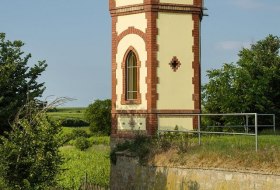
The Heisje was built around 1900 in the style of Neo-Gothic architecture. It is a hexagonal Neo-Gothic tower with a battlement. The ground floor, framed by a retaining wall made of field stones, used to serve as a shelter, while the ground level is situated at the height of the vineyard terrace above the Rhine plain. The red bricks gave the tower its name. Since 1927, it has been owned by the Glaser family. In 2000, the tower was chosen by the Wine Brotherhood Rheinhessen as the most beautiful vineyard cottage in Rheinhessen. In 2019, the…

The Schillerplatz is one of the central and historically significant squares in Mainz. Named after the poet Friedrich Schiller, it is today a lively meeting place with a striking historical backdrop, characterized by magnificent noble palaces such as the Osteiner Hof and the Erthaler Hof. Its baroque appearance bears witness to the urban development of past centuries, and the square is closely linked to the Mainz Carnival: Every year on November 11th, the fifth season is ceremoniously opened here. In the center of the square, the Carnival…