
searchMenu
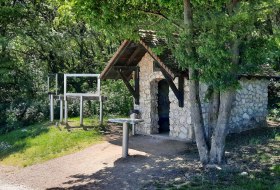
The Falkenberghütte, located above Dienheim, offers hikers along the RheinTerrassenWeg the opportunity to take a break. The hut, donated by the Dienheim Reconstruction Community, invites for a well-deserved rest after an eventful hike through the beautiful landscape. Two large panoramic windows reveal a fascinating panorama that opens up the view towards the historic Oppenheim and the charming Dienheim. The gentle hills of Rheinhessen with their picturesque vineyards provide a dreamy backdrop for beautiful photo motifs.
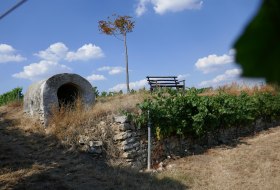
The Oriental Heisje Here you can see a stout little house with a barrel roof, which was also commissioned by Unterfauth Hirschel in 1766. It consists of three walls, with the door opening facing south. The door frame is a special feature, as it hints at the shape of an onion tower. Height: 185 District: "Auf dem Staatsbühl" Place Names: 1382: off Stahelbohel 1399: an stahelbuhel 1400: uff dm Stahelsbuhel 1600: uf dem Staßbühel 1681: auff den Staasbühel 1934: Auf dem Staasbühl 1954: Auf dem…

The church, built in 1863, is a simple rubble stone structure with a rectangular floor plan oriented east-west. The entrance in the east leads through a park-like forecourt with linden trees, where the congregation annually celebrates the "Kirchgartenfest – Unter den Linden." The slate-covered gable roof is equipped with small dormers on both sides. The side walls are characterized by four colorful stained glass windows each, extending over two floors. One enters the interior via a few steps, where the centerpiece is the organ from…

The Schillerplatz is one of the central and historically significant squares in Mainz. Named after the poet Friedrich Schiller, it is today a lively meeting place with a striking historical backdrop, characterized by magnificent noble palaces such as the Osteiner Hof and the Erthaler Hof. Its baroque appearance bears witness to the urban development of past centuries, and the square is closely linked to the Mainz Carnival: Every year on November 11th, the fifth season is ceremoniously opened here. In the center of the square, the Carnival…
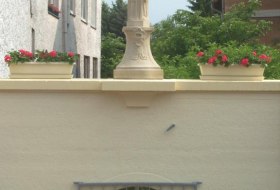
As a "bridge saint," John of Nepomuk was drowned in the Vltava River in 1383 because he refused to reveal the confessional secret of the queen. His statue from 1771 was stolen and replaced by a new statue in 2005.
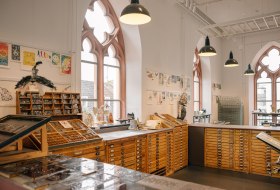
The printing shop in the Gutenberg Museum Mainz serves as both a print workshop and an experimental laboratory, forming the central museum educational offering of the institution. Here, visitors of all ages – from children to teenagers to adults – can experience the "black art" of printing up close, design their own printed materials, and experiment with lead and wood types as well as printing presses. Numerous workshops, guided tours, and creative programs such as children's birthdays or holiday offers convey the history of the…
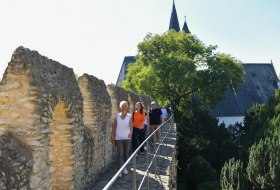
The all-around accessible main wall was mainly constructed in the 15th century. Its most vulnerable flank at the Mainzer Berg was strengthened by the addition of a Zwinger (inner defence gate). The only entrance (at Grabengasse/Kirchgasse) received an outer gate, a so-called “Barbarkane”. The second, southern breach was created in 1873 and provided access to the vineyards. The most salient point is the so-called Malakoff tower - formerly the “Alte Wache” (old guard post) with its dungeon. It offers an impressive…

The museum exhibits original finds from the Urrhine near Eppelsheim, which are around 10 million years old, and casts or copies of rare fossils. These include teeth and bone fragments of rhinoceroses, great apes and proboscis animals such as dinotheria and mastodons. Single specimens of the primeval horse, tapi r( claw-footed hoofed animal), Muntja deer, bear hound, beaver and pig are also on display. The centrepiece of the museum is a cast of the skull of a Dinotherium (Dinotherium giganteum), which was recovered from Klipstein and Kaup in…