
searchMenu
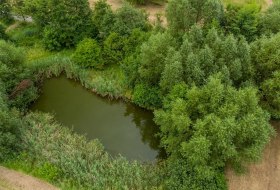
The Rohrwiesen biotope can be seen from far away on the Hiwweltour Zornheimer Berg. The many species in the biotope welcome hikers with an intensive natural background noise, which only decreases when the Hiwweltour passes into the vineyards.

The stone was erected around 1832 and commemorates the construction of the "Ingelheimer Grundstraße" (1829-1832), which here to the west of Stadecken intersected the country road from Mainz to Bad Kreuznach over Sprendlingen.

The parish church of St. Quintin is considered the oldest parish church in Mainz and was first documented in 774. It is a late Gothic hall church that was built between 1288 and 1330. The tower, built in 1489, once housed a watchman's apartment. Today, it holds four bells, including the oldest bell in Mainz, the so-called “Lumpenglöckchen” – a bee-skein bell from around the year 1250. The high altar features a life-sized statue of Saint Quintin, the patron saint of prisoners, on the left, and Saint Blaise, the second…
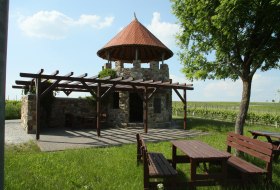
In collaboration with the Spiesheim Farmers' Association, the local community of Spiesheim built the Wine Tower in 1998. The Spiesheim Wine Tower was the first within the Wörrstadt municipal association. It has become a true landmark of our hometown to this day. The tower brings many people together from near and far; family celebrations, hiking trips, and much more regularly take place up here. On beautiful days, the view offers a fantastic panorama of the Rheinhessen hilly landscape, with a total of 28 local communities visible from…

The mercenary leader and the poet - the heyday and downfall of Ebernburg Castle The Hutten-Sickingen Monument If you take the B 48 to Bad Münster am Stein-Ebernburg, you will see the hill of Ebernburg Castle in front of you, as it has been rebuilt since the 19th century. A second glance reveals a group of figures halfway up the hill. There, cast in bronze, are the knight Franz von Sickingen (1481-1523) and the poet Ulrich von Hutten (1488-1523), crowned with the poet's laurel by the emperor. Both stand for a moment in world history…

For several centuries, ship mills operated on the Rhine River near Ginsheim. Up to 21 of these floating small businesses for grain processing were anchored here simultaneously, before they had to make way for the rising industrialization and increasing shipping traffic. Today, the authentic reconstruction of the last productive Rhine ship mill offers interesting and exciting insights into the technology and working conditions of past times.

The tower built around the year 1000 and the old silent organ from 1784, along with the beautiful stained glass windows and a wing altar, provide a successful cross-section through different eras. During the Thirty Years' War and also in the War of the Palatine Succession, the church, regarded as the main fortification of the village, was heavily damaged and partially destroyed. In 1706, it was assigned to the Protestants, who renovated it with a flat ceiling in 1725. Even after several renovations, the overall structure of today's church…

The former Rheingräflich von Salmsche court pharmacy was founded in 1728. The privilege to run a pharmacy was granted by the Raugraf von Salm to court pharmacist Friess. In 1790, the pharmacy was taken over by Dietrich Christ Dassel. The building was originally a baroque plaster construction and was renovated in a Gründerzeit style in 1886. Today, the pharmacy is owned by the Hohe family.