Evengelische Kirche St. Martin Wackernheim

Ingelheim am Rhein

The Protestant Church of St. Martin

Already in 788, a church dedicated to Saint Martin is mentioned in a document from Fulda. At that time, the church was in the possession of the local noble family of Otakar. In 1348, it belonged as a parish church to the Wackernheim church community. In the mid-16th century, at the instigation of the Electoral Palatinate, first the Lutheran and then the Reformed confession was introduced. During the church division, the heavily damaged church, which had been severely affected by the Thirty Years' War, fell to the Reformed, who made up the…

Kirschgarten

Mainz

Old town Mainz

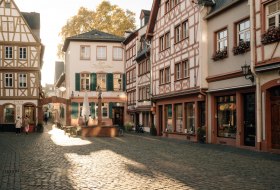
The old town of Mainz is marked by its tumultuous history. This is evident in the sight of the medieval cathedral, the old patrician houses, the Electoral Palace, the winding alleys, and picturesque squares. In contrast, the modern buildings - the town hall designed by Danish architect Arne Jacobsen in 1971, the Brand shopping center, the Rheingoldhalle, and Fort Malakoff - testify to the passage of time. History and culture, bloom and decline over the last 2000 years are reflected in a stroll through the old town. Here, bounded by the…

Weedplatz

Monzernheim

Weedeplatz

In 2003, the square in the town center was redesigned. The centerpiece of the square is the fountain. Water bubbles here from a large hewn sandstone, which stands under a shade-giving chestnut tree.

Cenotaph of Drusus

Mainz

Drususstein

There is an air of reverence and mysticism about the Roman castle of Mainz. Soldiers in battle gear walk around a huge bonfire, placing weapons and gifts at its feet. Laments fill the air, and the fire throws eerie shadows onto a cenotaph ... We can only guess what the elaborate annual memorial services held in Roman times in honour of general Drusus entailed. All that has remained of his cenotaph is a 20 m high masonry block on the grounds of the citadel of Mainz. Nero Claudius Drusus was a step son of Emperor Augustus. In 13 BCE, Augustus…

Die Ruhen

Wörrstadt

„Die Ruhen“ / Säule vom Wörrstädter Schloss

At the entrance to Ulmengraben on Paris Street, opposite the Catholic Church at "Neutor" Square, there are stone frames in the shape of gallows. These so-called "Ruhen" (resting places) were previously used by farm women to set down their loads and originally stood "in the Oberfeld," meaning in the area above the Schlossberg. Additionally, a column of the former Wörrstadt Castle is still preserved at Neutor.

City Hall

Mainz

Rathaus der Stadt Mainz

Note: The Mainz City Hall is currently undergoing renovation. In November 2019, the resident offices moved out. Colloquially, it is jokingly referred to as the "Fox Den" (in reference to the serving Mayor Jockel Fuchs at the time of its inception) or "Civil Servant Prison": The Mainz City Hall is undoubtedly a characteristic building with its own unique architectural language. Previously, Mainz had been without a city hall for five centuries – until the Mainz City Council commissioned the renowned Danish firm Jacobsen and Weitling to…

Gästeführung

Oppenheim

Guided tours by cultural and wine ambassadors

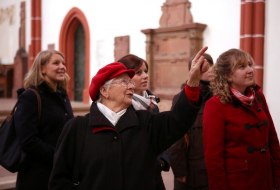
Experience the region together with the culture and wine ambassadors. In addition to the fixed dates on Wednesdays at 6 pm, Saturdays at 3 pm and Sundays at 3 pm, the KuWeiBos offer individual events (guided tours, wine tastings, bus tours, etc.). Whether you are looking for a way to discover Rhein-Selz privately or as a company outing - the culture and wine ambassadors are happy to plan according to your individual wishes. Many offers are also barrier-free - just ask! An overview of the events already planned can be found on the website…

Neunröhrenbrunnen

Wörrstadt

Neunröhrenbrunnenplatz

The nine-tube fountain, built in 1608, is one of the most beautiful village fountains in Rheinhessen and is the landmark of Wörrstadt. The structure of the fountain is crowned by a group of two upright lions holding the grill of Saint Lawrence in their front paws. These animals are the heraldic symbols of the Rheingrafen. Water flows from nine tubes into a fountain chamber. From here, the Mühlbach is fed. Not only can the nine water-spouting tubes of the fountain be used for much-needed cooling, but the outdoor gastronomy can also…