
searchMenu

Here you have the opportunity to take a holiday photo of a special kind. Capture a beautiful holiday memory with the charming Rheinhessen landscape. The 70-hour campaign of the Federation of German Rural Youth in May 2019 was a complete success for the local group Monzernheim. Through collaborative efforts, the rural youth from Wonnegau were able to implement their idea of picture frames and thereby enhance the tourist offerings in the region. Once the steel constructions, each adorned with two Rural Youth logos, were completed, they could…
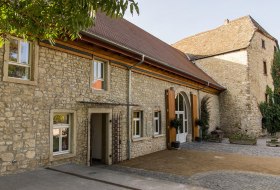
A cultural provider with magnetic appeal Initially, it was a rather small group of culture enthusiasts from Stadecken-Elsheim, led by founding chairperson Heidi Burkhart and Stefan Christiansen, who was responsible for finances from the beginning, that founded KiStE - Culture in Stadecken-Elsheim - in 2003. It was intended to be a local citizen initiative for the permanent establishment of a diverse range of events in the Selztal community. Today, the number of members stands at nearly 60, who have dedicated themselves - under the…
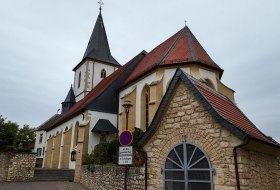
The church is the oldest building in the town. There was originally a wooden basilica here, which was mentioned as early as the 9th century, followed by a stone building from the 13th century. The choir with sacristy visible today dates from 1492 and the tower was built around 1520 as a defensive tower. The nave was expanded into three naves in 1911 based on Gothic styles.
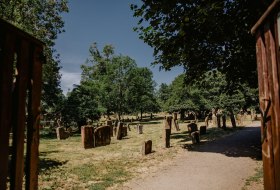
In July 2021, the cities of Worms, Speyer and Mainz were awarded the title of World Heritage Site by UNESCO for their ShUM sites. The cities are considered the cradle of Ashkenazi Judaism. Discover the Jewish monuments in Worms and their significance for the cultural heritage on this guided tour. You will visit the oldest preserved Jewish cemetery in situ in Europe, the ‘Holy Sand’, as well as the former Jewish quarter in the Judengasse with the synagogue. The monuments illustrate Jewish life in the city and, together with the…

For several centuries, ship mills operated on the Rhine River near Ginsheim. Up to 21 of these floating small businesses for grain processing were anchored here simultaneously, before they had to make way for the rising industrialization and increasing shipping traffic. Today, the authentic reconstruction of the last productive Rhine ship mill offers interesting and exciting insights into the technology and working conditions of past times.
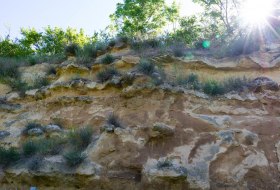
The Geotope in Alzey-Weinheim shows sea deposits from the time of Tertiar (Oligozän) over 30 Million years ago. It is also a former seabed, not a coastal cliff.
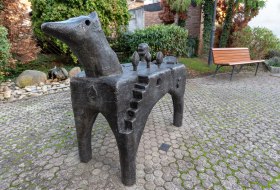
Liesel Metten Sculptures Path Nieder-Olm Join us on an unusual and exciting artistic journey in the center of Nieder-Olm. Rarely can one observe the artworks of a renowned sculptor couple in such close proximity. We are talking about the sculptures of Liesel and Johannes Metten in the public squares of our town. Between 1977 and 2016, a total of 14 works in bronze were created - animal figures and mythical creatures that have conquered the public space in Nieder-Olm. On small brass plaques, viewers can read the title, the year of creation,…

The Oswaldhöhe is a vantage point from which you can let your gaze wander over the Rhine-Hessian village of Bornheim. There is also a table of wine here.