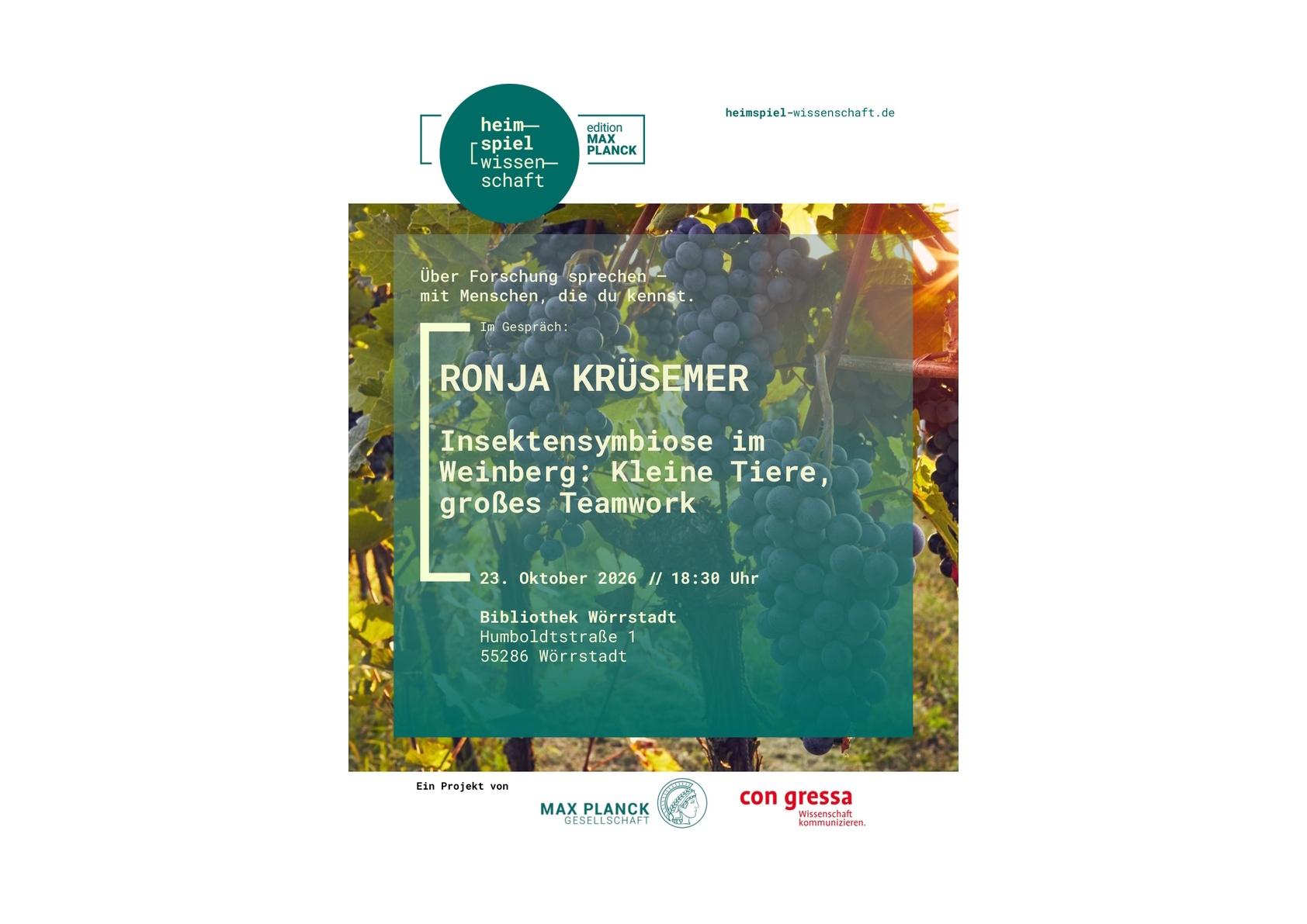
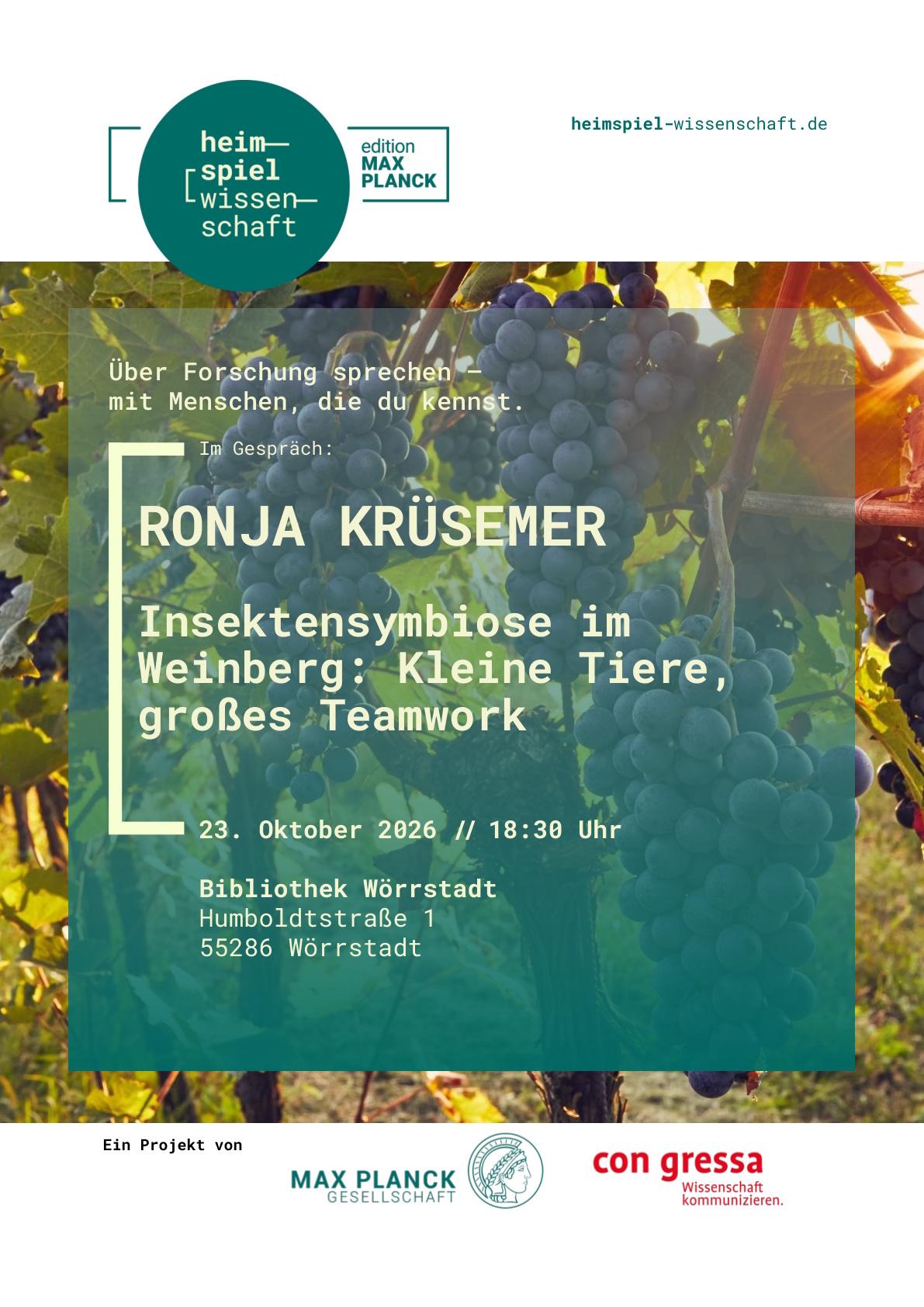
Heimspiel Wissenschaft Insektensymbiose
Wörrstadt
on 23.10.2026 at 18:30 o'clock

Wörrstadt
on 23.10.2026 at 18:30 o'clock
Ronja Krüsemer, Max Planck Institute for Chemical Ecology
Insects are everywhere: They buzz in the vineyards, crawl on flowers, or hide in the foliage. And yet we often know surprisingly little about them – and even less about the tiny "pets" that many of them carry within.
It is precisely here that Ronja Krüsemer's research comes in: She explains the coexistence of two different species – symbiosis – and how both benefit from their respective partners. Symbioses can be found in nature time and again, especially in the animal kingdom among insects. Insects are the most diverse group of animals on our planet. Their success in colonizing various habitats largely depends on their ability to form symbioses with bacteria and fungi. Their partners in symbiosis provide the insects with a range of useful products – for example, antibiotics or amino acids. This allows insects to digest food that would otherwise be indigestible, to defend against predators or pathogens, or to survive in extreme habitats.
The problem: Many of these symbionts have become so accustomed to life within their host over millions of years that they can no longer survive outside the insect. These bacteria are typically not cultivable – and the insect usually does not survive without its symbiont. Experiments are correspondingly challenging.
In her presentation at the Heimspiel Wissenschaft, Ronja Krüsemer takes her audience on a journey through the world of insect symbioses – featuring examples of insects found in the Rheinhessen region. Part of the presentation will include engaging examples that provide an overview of the various functions of symbionts.
Ronja Krüsemer grew up in Wörrstadt. She connects much more with her homeland than just her origins – expansive vineyards, a cool glass of white wine (ideally paired with Spundekäs and onion cake), and an active club culture. Since 2021, Ronja Krüsemer has been pursuing her doctorate at the Max Planck Institute for Chemical Ecology in Jena.
Following her presentation, there will be time in a relaxed setting to discuss and ask questions – either about the topic itself or simply about life as a scientist. The presentation is public, free of charge, and suitable for young and old alike. Refreshments and snacks will be provided.
Venue:
Bibliothek Wörrstadt Humboldtstraße 1 Wörrstadt