
searchMenu
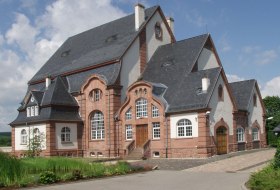
To secure the water supply in the Rhine-Selz region, the “Rhine-Selz Region Water Association” was founded in 1905. Due to the favorable local conditions, the necessary water extraction and supply was to be carried out from Guntersblum. It was therefore decided to build a waterworks with pumping facilities on site. Construction began in May 1906, and after a relatively short construction period, the facility was inaugurated in October 1907. The waterworks was built from red Palatinate sandstone in a Baroque Art Nouveau style and…
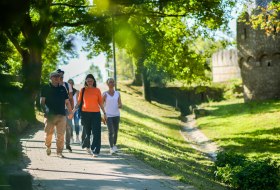
On the east flank of the Mainzer Berg the old defences are particularly massive and here are probably the best remaining parts of the wall, watchtowers and the low laying obstacle in the ditch. Here the Breitbach feeds the ditch. The romantic part along the so called Seufzerpfädchen (path of sighs) - it was the path where lovers used to meet - runs from Rinderbach (now Schillerplatz) to the traditional red-wine festival site and meets the outer courtyard at the Burgkirche – the starting point for every round-trip of the city…

The present church, dedicated to St. Joseph, was built in 1891 and stands on the site of the Ursula Chapel, which was erected in 1745 and of which two sections of wall remain. During the First World War, the bells were melted down, and three new ones were cast in 1934, but two bells had to be surrendered again during the Second World War. In 1965, the church was extensively restored and given new windows. Particularly noteworthy is the rose window above the altar in the choir room, which depicts the Good Shepherd and scenes from the New…

In 2017, the Saubachtal, named after the Saubach, was extensively renatured. Thanks to several created ponds, the Saubachtal offers an ideal retreat for animals and plants. A rest area with a quiet bench invites you to linger in the most beautiful spot.

A cultural provider with magnetic appeal Initially, it was a rather small group of culture enthusiasts from Stadecken-Elsheim, led by founding chairperson Heidi Burkhart and Stefan Christiansen, who was responsible for finances from the beginning, that founded KiStE - Culture in Stadecken-Elsheim - in 2003. It was intended to be a local citizen initiative for the permanent establishment of a diverse range of events in the Selztal community. Today, the number of members stands at nearly 60, who have dedicated themselves - under the…

The Bad Kreuznach Puppet Theater Museum presents a fascinating permanent exhibition on puppet theater culture worldwide and in Germany. Visitors experience the history of the Augsburg Puppet Box and the Salzburg Marionette Theater up close, from the carving workshop to the finished wooden head. The UNESCO-recognized puppet play traditions, from Chinese shadow figures to Sicilian knight marionettes, can be seen, and with 55 (!) interactive stations, the exhibition allows for SELF-EXPERIENCE, PARTICIPATION, or LISTENING. The PuK Museum will be…

The Old Transformer Tower in Sulzheim combines history, art, and nature across three levels. For more than five decades, the building served to convert medium voltage to low voltage, thereby securing the electricity supply of the town. With the laying of all cables underground in 2009, the tower lost its original function and was subsequently sold. A private owner took over the structure with the aim of creating a place for encounters. Today, the transformer tower houses public exhibitions as well as events related to art and music.…

The trullo, or rather the trulli (plural), as there are 6 of these vineyard houses around Flörsheim-Dalsheim, originally served as a shelter for the field marksmen (Wingertsschützen). At the time when most of these houses were built - in the middle of the 18th century - their main task was to protect the vines and the vineyard stakes from wood theft. The Trullo am Nussbaum in Flörsheim-Dalsheim was awarded a prize by the Rheinhessen Wine Brotherhood in 2016 - on behalf of all the Flörsheim-Dalsheim trulli - and stands at a…