
searchMenu

The Love Nest Built by Daniel Graf from Monzernheim in 1934. It is a brick building with a concrete flat roof and a rubble stone foundation. Inside, a small bench has been placed all around. The eastern wall clearly shows that it was a popular shelter for lovers and still is. Height: 182 Area: "In the middle valley" known as "Rabbit Hole" History / Stories / Anecdotes: The current owner is the Keller Winery / Flörsheim-Dalsheim (since 2014). Previously, it belonged to the Mayer Winery from Ober…

On the outskirts of Kriegsheim, the dominant property of the Wiesenmühle farmstead rises with its prominent tower. The main building dates back to the 17th century and, together with the 3 large outbuildings, forms a closed, rectangular courtyard, which was acquired in 1816 by the Kriegsheim Mennonite Johann Mundorf. Since the transfer of ownership to the Schilling family in 1899, the main focus has been on arable farming. Viticulture is also a mainstay of the farm's agriculture. The mill itself is no longer in operation. In the "Old…

The predecessor building standing in the middle of the walled churchyard was dedicated to all saints. However, it had to give way to the current structure in 1755, which is characterized by a uniform design from the time of its construction.

The construction of a forester's lodge in the second half of the 18th century is linked to the appointment of a kurfürstlichen forester. He was responsible for the entire Ingelheimer territory. The government aimed to combat the ongoing wood shortage with targeted reforestation. Sand dunes in the Nieder-Ingelheimer district were planted with pines. The wooded floodplains of the Rhine were managed. With the oversight of the planting of white mulberry trees to promote silk production, the forester received an important additional task…

The vineyard cottage, estimated to be around 150 years old, was awarded a prize by the Rheinhessen Wine Brotherhood in 2015 after being expertly restored and refurbished by dedicated citizens of Uelversheim. A lovingly designed outdoor area provides opportunities to relax and linger. The earth-covered barrel-vaulted rectangular building of the Graunsberghäuschen invites visitors to sit down on a brick bench that runs around the interior. On the K41 road to Oppenheim on the left-hand side (second dirt road before the farmstead), a paved…
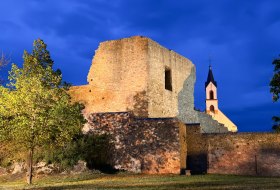
The castle Neu Baumburg, also called Neu-Bamberg, Neubamberg, is the ruin of an elevated castle above the community Neu-Bamberg. It was built around 1253 by the Raugrafen, mentioned in 1253 as "Novum castrum apud Sarlesheim" and in 1283 in the possession of the Raugrafen Heinrich II of Neuenbaumburg. On April 12, 1338, half of the castle and the village was pledged by the roughnecks to Archbishop Heinrich III of Mainz for 1,300 pounds of heller and on March 11, 1419, Archbishop Johann II of Mainz and Count Johann V of Sponheim-Starkenburg…

Mysteriously, without revealing its history, on the slope of the L430 feeder road from Udenheim to the former B 40, now the L401 in the Nieder-Saulheim district, stood the little shrine, popularly called "Heljerheisje". The Gothic wayside shrine has a four-sided base made of limestone. The upper, widened half contains four niches facing all points of the compass, which are protected against wind and weather by a roof-like closure. Inside the niches there were probably figures of saints in earlier times. The Heiligenhäuschen was mentioned…

The bridge chapel in the land pier of the Drusus Bridge is probably the oldest preserved bridge chapel in Germany and the only underground one. The bridge chapel in the Drusus Bridge, 2021. Unfortunately, we do not have a current photo of the interior of the chapel in the city archive, hence this one from Wikipedia. Marion Halft: Early Romanesque bridge chapel under the Drusus Bridge, Bingen on the Rhine. CC-BY SA 4.0. Carved from the slate rock of the right bank of the Nahe, it lies on the axis of the Nahe Bridge 4.50 meters below the…