
searchMenu

Protestant parish church, formerly St. Nicholas Collegiate Church. The large building with its high tower to the west dominates the Obermarkt with its long side. Despite severe damage during the War of the Palatinate Succession in 1689 and World War II, the three-nave hall offers an impressive, albeit somewhat austere, interior, due to the loss of most of its furnishings. Some of the tomb slabs erected in the nave originate from the Cistercian convent of Weidas, which was located near Dautenheim and was destroyed in the 16th century. The…

The cross vault in the Korfmann Winery, built in 1840, was turned into a wine tavern in 1999, which can accommodate up to 50 people. General information on Rheinhessen cow chapels .The origin of the typical Rheinhessen vaults goes back to the early 19th century. At that time, farmers wanted to increase the yield of their cattle by keeping them in stables and use the leftovers as fertiliser for their fields. Initially, the cattle were housed on the ground floor of the half-timbered houses, above which hay and straw were stored. However,…

Hinkelstein A Hinkelstein has been mentioned at this location since the 14th century. The original stone is very likely built into the dry stone wall. The current stone was erected in 2004 and originates from a foundation uncovered during sewer construction in Osthofen, alongside which Roman bricks were also found. Height: 188 District: "Am Hinkelstein" History / Stories / Anecdotes: A Hinkelstein has been mentioned here since around 1300. According to the Monzernheimer chronicler, teacher Georg Wendel, it was removed…

In the charming wine village of Guntersblum, you will find the Guntersblum Museum. With great passion, it is run by the Association for the Preservation of Guntersblum Cultural Heritage e. V. on a voluntary basis and surprises with three to four changing exhibitions each year. The focus is on regional history – complemented by exciting topics with an international perspective. Additionally, artists and cultural creators from all over the world are given a platform here. The museum is open on Sundays and public holidays from 2 PM to 5…

The Ebernburg Castle is enthroned on a hill high above the Bad Münster am Stein district. It dominates the town and landscape. The castle can be reached on foot on a stairway or by car, whereby one must cross the village. Once you reach the top, the entire wealth of the landscape opens up to the observer.There you can see the mighty Rotenfels (Red Rock) steep face, formed of solidified magma, the village of Ebernburg, which nestles around the castle hill, the Nahe weir with the rock formation of the Rheingrafenstein and to the…

In the 11th/12th century, the parish was assigned to the diocese of Worms. The construction of the bell tower in Romanesque style, which has been preserved to this day, probably dates from this period. in the Romanesque style probably dates from this period. In the late 18th century, the church was extensively rebuilt. 1699-1705 Used simultaneously by Catholics and Reformed. 1706 Handed over to the Catholic parish. At the end of the 19th century, the bell tower was added and rebuilt on its present site. The silent organ still preserved…
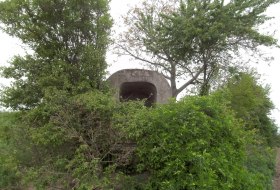
The Mission Heisje Shelter house from the year 1766 Sturdy construction made of quarried stones with a barrel roof. In the 1980s, the Heisje was renovated and equipped with a concrete plaster. At the same time, the staircase and terrace were cast, and a railing was installed. Between 1983 and 2005, there was a "note mission" there: Believers could supply themselves from an open mailbox with Bible quotes and praises from the Marian Sisters from Darmstadt-Eberstadt. Can you find the two psalms that are still displayed on the…

The soil profile is part of the Gau-Algesheim geoecological adventure trail. A soil outcrop and an information panel provide information about the formation of the Mainz Basin's calcareous tertiary.