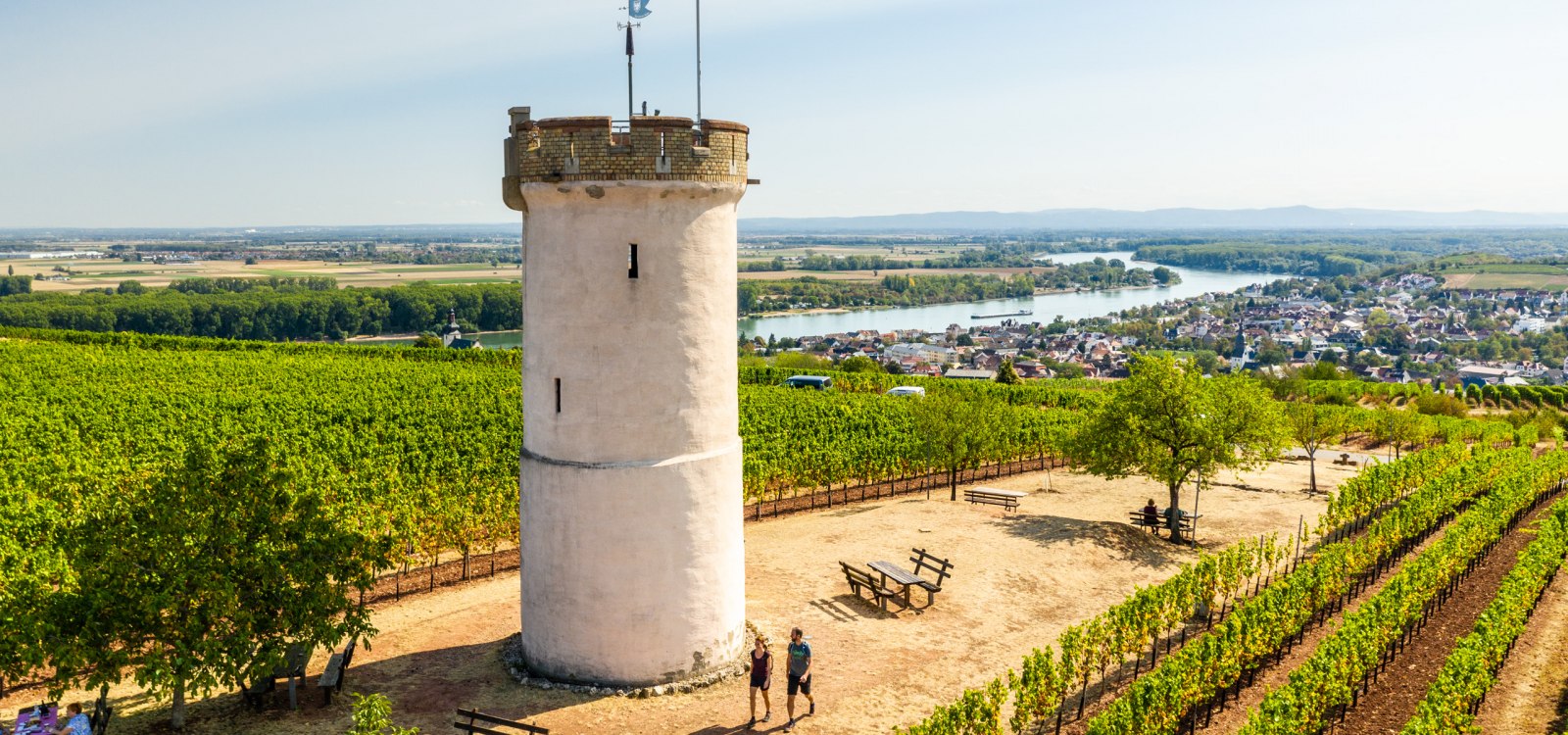
Hiking couple at the watchtower in Nierstein, © Dominik Ketz© Dominik Ketz

Culture on the hiking trail

Sights on the RhineTerrassenWeg

The Kaiserdome in Worms and Mainz, the Katharinenkirche in Oppenheim or the Rote Hang in Nierstein are known far beyond Rheinhessen and are an absolute highlight of every hike. But the RheinTerrassenWeg lives especially from the gems and moments in the wine villages. People like to talk about their regional attractions. Let yourself drift and enjoy the culture and the stories on the RheinTerrassenWeg.

worms-dom-st-peter-c-Uwe-feuerbach_uwe4713 © Uwe Feuerbach

Worms

Cathedral of St. Peter

The double choir, romanic pillar basilica with transept was set up in 1125/1130 and 1181 on the fundament of the already built cathedral. The ' argument of the queens' of the 'Nibelungenlied' took place at the so- called imperial portal on the north side. The gothic chapel of st. nicholas is situated next to the south portal. Inside of the cathedral are romanic and late gothic stoneworks. The east choir was furnished baroque after the city destruction in 1689. The high altar is from Balthasar Neumann. In 1048 the cathedral experienced a pope…

Jüdischer Friedhof

Worms

Jüdischer Friedhof "Heiliger Sand" Worms

The oldest Jewish cemetery in Europe has around 2,000 graves, the oldest gravestone dates from around 1058/1059 and is part of the UNESCO World Heritage SchUM Sites Speyer, Worms, Mainz - Jewish Heritage for the World. From the part on the former city rampart you have an impressive view of the cathedral, the so-called "Martin Buber View". The old Jewish cemetery "Heiliger Sand" is still of great importance to Jews worldwide. Numerous influential Jewish scholars and rabbis were buried here. The oldest gravestones date back to 1058/59 and thus…

Worms Lutherdenkmal-c-Uwe-feuerbach_uwe4809 © Uwe Feuerbach

Worms

Reformationsdenkmal „Lutherdenkmal“

One of the largest Reformation monument complexes in the world was designed by the Dresden artist Ernst Rietschel, executed by his students Adolf von Donndorf, Gustav Kietz and Johannes Schilling and inaugurated on June 25, 1868. In the middle, Luther stands on a high pedestal and holds a fist on the Bible, alluding to the Worms Reichstag. Seated at his feet are Petrus Waldus (France), John Wyclif (England), Jan Hus (Bohemia / Czech Republic) and Girolamo Savonarola (Italy), four European reformers who worked before Luther. Wall battlements,…

Lutherkirche

Worms

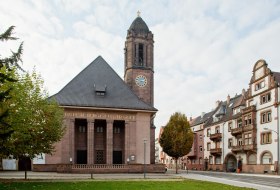
Lutherkirche

The Lutheran church in the west of the city centre was built between 1910 and 1912 according to plans by Prof. Friedrich Pützer. It is easy to recognise the strong echoes of Darmstadt Art Nouveau with sparse ornamentation on the outside. The octagonal Luther rose appears several times throughout the church. The single-nave hall building has a pulpit altar.

Schloss Herrnsheim parkseits

Worms

Schloss Herrnsheim

Herrnsheim Castle, located in the district of the same name, stands on the remains of a castle built in 1460. A baroque castle was built there from 1711, but was badly damaged in 1792. When it was rebuilt, today's castle was constructed in the Empire style of Prince von Dalberg with rare French paper wallpaper and a library tower. French paper wallpaper and a library tower. An English garden with meadows, wooded areas, a pond and an island as well as an orangery were created around the palace. The ‘Green Parlour’ is also used as a…

Bergkirche Osthofen

Osthofen

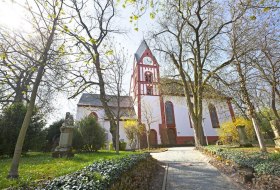
Bergkirche Osthofen

The listed Bergkirche is located on the Goldberg above Osthofen. The church has a tumultuous history and has been expanded and rebuilt repeatedly. From the chapel and a neighboring estate, a castle complex developed towards the end of the first millennium, which was used by the Vogts for Osthofen. In 1241, this fortification was demolished at the request of the Worms citizens after a dispute between the city of Worms, supported by Bishop Landolf of Hoheneck, and the citizens of Osthofen; however, the church remained intact. During the Thirty…

Leckzapfen Osthofen1

Osthofen

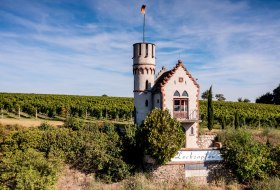
Miniaturburg Leckzapfen

The miniature castle Leckzapfen was built in 1891 by the brother of the Rheinhessen composer Wendelin Weißheimer, the estate and mill owner Gustav Friedrich Weißheimer (1831-1904), who was based in Osthofen, on his eponymous vineyard. The building, which was extensively restored a few years ago at the initiative of the Kulturnetzwerk Osthofen e.V., bears a striking resemblance to the romantic fairy tale castle Lichtenstein near the Swabian Jura, whose historicist reconstruction is based on the descriptions of the well-known novel…

Gedenkstätte

Osthofen

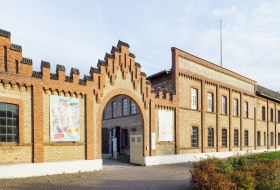
National-Socialist Documentation Centre

In Osthofen, in an old disused paper factory on Ziegelhüttenweg, the only early concentration camp for the then People's State of Hesse was located from the beginning of March 1933 to the beginning of July 1934. Today, the Rhineland-Palatinate Nazi Documentation Center / Osthofen Concentration Camp Memorial is located here under the sponsorship of the State Center for Civic Education (LpB). The Project Osthofen e.V. support association, founded in 1986, works closely with the LpB. The concentration camp memorial in Osthofen is a place…